
Everything you want is on the other side of looking after yourself. You already know that.
You just keep putting everyone else first. You hold the team, the family, the calendar, the crisis — and you haven't taken a proper lunch since March.
Breathwork simple enough to actually follow, that calms your nervous system in ninety seconds on the days you have nothing left. Space to work out what you need now. And a clear look at where all that pressure came from. The reality is that most of what you're carrying didn't start with you.
You stop running your life from fear, and start running it from what you actually want.
14 & 21 October, then 4 & 11 November Mid-term week off — nothing to catch up on Every session recorded and sent to you Camera off entirely welcome
Cold water came before breathwork. It taught me my body could go from panic to calm in about ninety seconds — without me talking myself into it.
Here's your Tuesday
You ate at your desk again. Or in the car between two things. Or you got to four o'clock and realised you hadn't eaten at all, and you were almost proud of it.
Someone asked how you were and you said "grand, busy" before they'd finished the question. You weren't lying, exactly. You just didn't have a spare thirty seconds for the true answer.
There's an alarm going somewhere in you most of the day. Not a dramatic one. A low one. The sense that something needs handling, and it's yours to handle, and if you stop paying attention it will get worse. You're very good in a crisis — which is unfortunate, because it means you're rarely out of one.
You put out fires all day. Nobody asks who's putting out yours.
And you know. That's the part people miss. You're not someone who needs convincing that rest matters. You've read the books. You downloaded the app in a good week and haven't opened it since. You've booked things and cancelled them. You've told yourself the reset comes after this project, after the appointment, after Christmas, after the thing that's always about to be over.
Underneath all of it is a rule you never sat down and agreed to: everyone else's needs come first, and yours go last, and that's just how it is.
You didn't decide that. But you're the one living it.

What if instead
- You could calm your own nervous system in about ninety seconds — deliberately, in a car park before you walk in, rather than waiting to feel better by accident.
- You knew what you actually need right now, and could say it out loud without apologising for it.
- You understood where the pressure came from — whose it originally was, and how much of it was never yours to carry.
- You were replenishing yourself before the next big thing, rather than recovering after the collapse.
- You were moving from purpose and freedom rather than from fear and lack — and could tell the difference in the moment.
- You had the stamina for the darker months, instead of bracing for them the way you have every other year.
- You had two or three practices small enough to survive a bad week, not a routine that collapses the first time life interrupts.
- Putting yourself somewhere other than last had stopped feeling like selfishness and started feeling like basic maintenance.
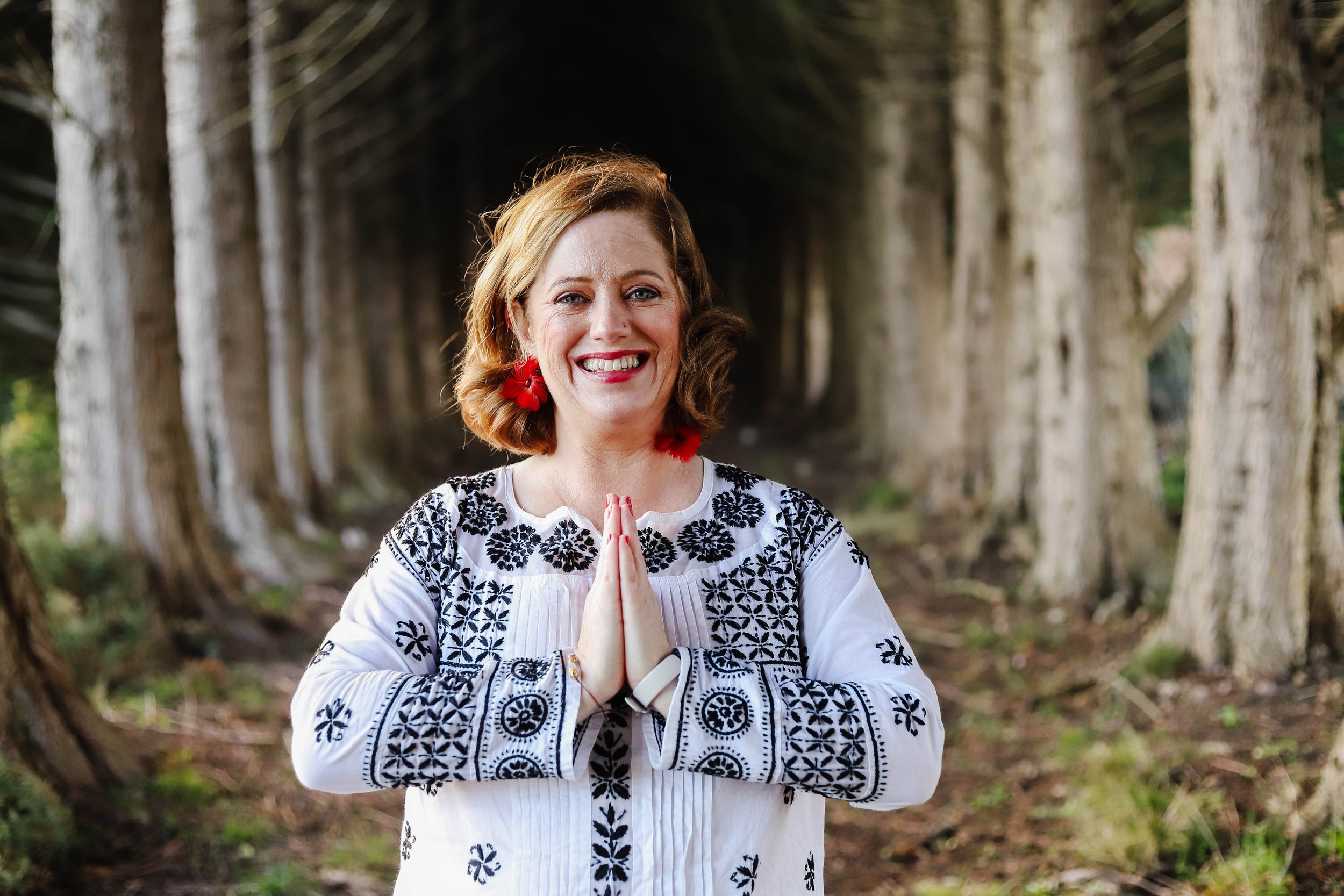
Why me
I'm Norma O'Kelly. I'm a transition coach and facilitator, based in Dublin, from Limerick originally — and I built Steady Ground because I needed it about ten years before I made it.
It starts early
Nobody sits you down and tells you that other people come first. You learn it. It works. You keep it — and thirty years later you're still running it, without ever once having said it out loud.
The calendar with no room for lunch
Twenty-two years in international marketing. That's the credential that matters most here, and it's the one I used to leave off. I know the 7pm call from another time zone. I know what it is to be genuinely excellent at your job and to have no idea what you actually want.
When I design something around ninety seconds rather than ninety minutes, it isn't a marketing decision. It's because I remember what ninety minutes was worth.
The day I knew something had to change
I was told I needed urgent surgery, and my first thought wasn't about my body. It was that the timing was awkward. Something big was happening at work, my team needed me — or I'd decided they did — so I tried to push the date out.
Sit with that for a second, because I didn't at the time. I was negotiating with a surgeon about whether a quarter at work mattered more than my own body, and the frightening part isn't that I did it. It's that it didn't feel strange. It felt responsible. It felt like what a good manager does.
That's the day I finally saw the rule I'd been living by: their needs were more important than mine. I'd never said that sentence out loud. I'd just quietly organised my entire life around it.
Then I trained in the part nobody else was doing
Breathwork calms the system. It doesn't tell you why the system is under load. So I trained systemically, in the tradition of John Whittington and Bert Hellinger — because I kept noticing the same thing in clients: the pressure they carried didn't start with them. It came down a line. A parent who never stopped. A family where being needed was how you earned your place. A workplace that rewarded it and a culture that celebrates the always-busy one.
That's why Steady Ground has both halves in it. The body, and where it came from.
I've been on the other side of most of this. I lived with endometriosis and six surgeries between 28 and 43, mostly while working in high-pressure environments, managing teams, travelling for work, and still being the good daughter and the good friend. I then cared for my mother through cancer. She died in 2019, at 71.
Since I started my own business I've gone through an immense transition in identity: feeling fear and still doing it anyway. I'm scared most days, but I have to get up and get on with it. I've had to learn to use breathwork, listen to my body, and still move.
And more recently I've found love. Something I had so often given up on. Now that he's here, this too is another uncomfortable and beautiful transition that needs support and steady ground.
I can't wait to share the grounding techniques I use daily to help me live the life I do and do the work I love. I tell you all this so you know I'm not working from a textbook. This is my life.
It's only these practices that let me keep going.
Come with me.
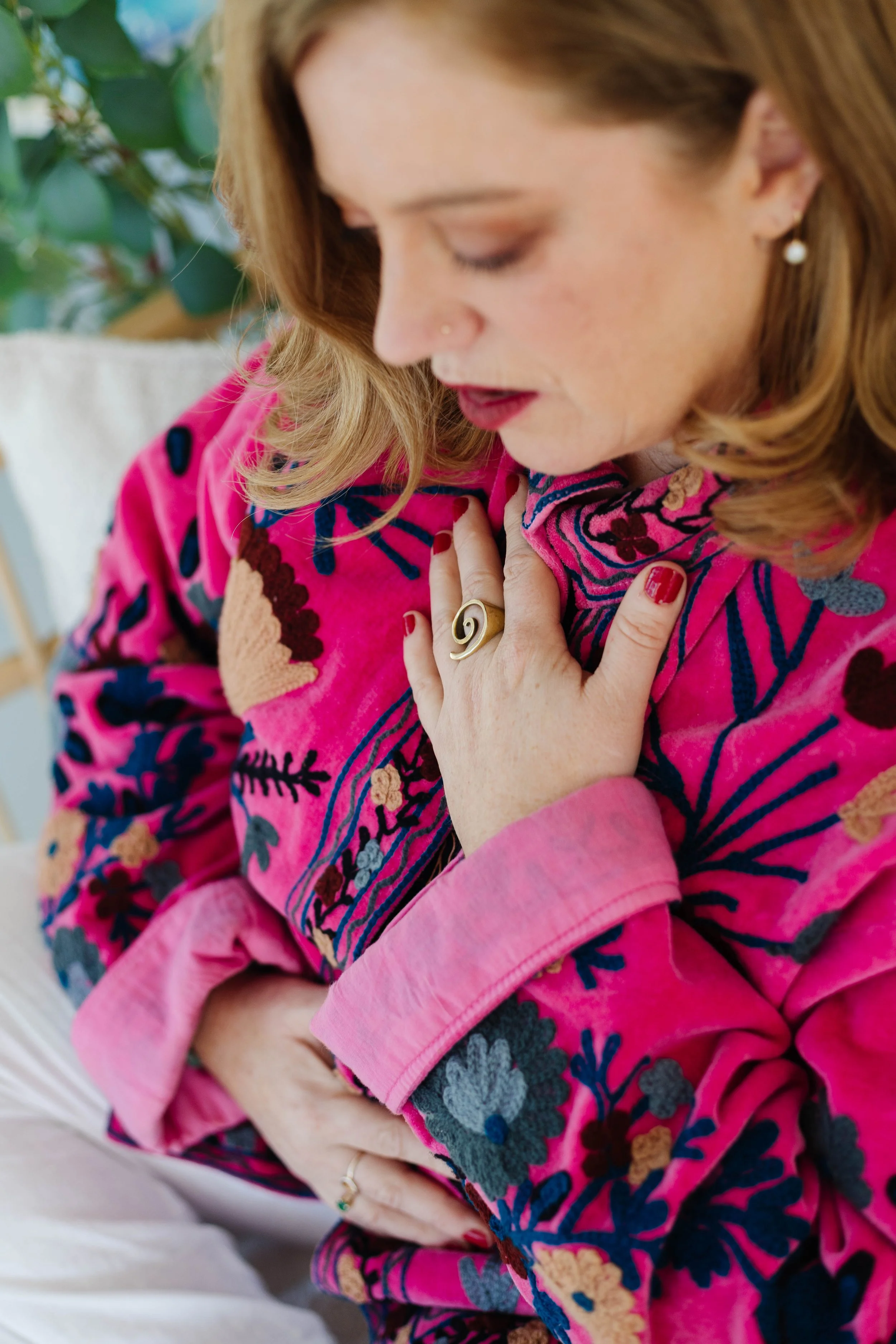
The season you're in
We are standing at a threshold. The light is going. The harvest is in. The year is turning toward winter — and yet almost everyone is being asked to produce at exactly the rate they did in June. September arrives and we all brace. By the end of October people are frazzled and can't quite say why.
I work with the Celtic wheel, and it runs through these four weeks rather than being bolted onto them. In the old calendar, Samhain — the last days of October — is the threshold into the dark half of the year. Not an ending. A turning.
Which is exactly why the programme falls where it does:
- Two evenings in the last of autumn — 14 and 21 October, while the light is still going.
- We break across the threshold — the week of 28 October.Time to integrate too and see if the techniques work before returning.
- Two evenings on the other side — 4 and 11 November, in the first weeks of winter, building what will actually carry you through it.
If you have spent every autumn of your adult life wondering why it gets so hard around now, this is part of the answer. You are not failing to keep up. You are being asked to grow at full speed in a season built for rest.
We are going to work with the season rather than against it. That alone changes could change your winter and therefore your spring.
I know what it is to lose your steady ground
And I'm not writing to you from the far side of it, with everything neatly resolved. I'm in a season of change myself.
I'm building my own business after twenty-two years inside someone else's structure. And I've found love later in life, which I had rather stopped expecting. Both of those are good things. Both of them have knocked me sideways more than once — because change doesn't only arrive as loss. Sometimes it arrives as exactly the thing you wanted, and it still asks everything of you.
What holds me steady is smaller than you'd think.
The sea, first and always. All year round, and yes, through the winter. It's my number one resource and the thing most people know me for — and there's a reason. Ninety seconds in cold water does more for my nervous system than an hour of trying to think my way calm. It taught me the whole method before I had a name for it.
Breathwork, every day. Including — especially — the days I don't feel like it. Getting outside, usually in weather I'd rather not be in. Coming back to my yoga mat.
That's it. Four things, none of them impressive, none of them an hour long. And they change absolutely everything.
I'm not teaching you what I wish I did. I'm teaching you what I actually do, on ordinary days, including the bad ones.

- You're the steady one. People bring their problems to you.
- You've hit a wall and you can't keep going the way you have been.
- You know you need to look after yourself and you keep sliding it down the list.
- You're caring for someone. Maybe a parent, a partner, a child and your own needs went to the bottom of a long list some time ago.
- You're in a transition. A new role, a loss, a diagnosis, or the kind nobody names: same job, same house, and you can't do it the way you used to.
- You're not at sea.. something's coming, and you want to resource yourself before it rather than after.
- You've tried things before and lost them when life interrupted. This is the most common one, and it's designed for.
- You're in acute crisis right now. Please get the right support first — a GP, a therapist. I'll be here when you feel more ready.
- You want a guaranteed outcome. I can't ethically give you one and I won't pretend otherwise.
- You want something to listen to in the background while you work. This asks for real time with nothing else happening, and that's the point of it.
- You want to be pushed. That's not how I work. Nothing here is intense, and nobody will make you share anything.
What people say afterwards
Thank you for holding space with me this week. It was very powerful energetically and you are a wonderful facilitator.
— After a one-to-one sessionI've been integrating our session all week. It was a very grounding experience and I'm wiring in a lot of self trust.
— A week laterI feel stronger and more and more at peace as the days go by.
— Coaching clientLand, See, Shed, Grow
Four evenings that we journey together on. It's a gentle spiral. You come back to the same ground each week and find you're standing on it differently.
Arriving in your own body
You cannot think your way onto steady ground. You have to land on it. Nothing sensible gets decided from alarm, so we start with the body. You'll learn three breath practices that work in real conditions — at a desk, in a car park, in bed at 11pm.
And this is more than three breathing exercises. When your system has been running hot for years, you stop being able to tell the difference between what's urgent and what's simply loud. Giving your nervous system proper support is what lets the discomfort underneath finally surface instead of being managed. Most people feel their own system come down on purpose for the first time, and describe it as a shock.
Seeing more of yourself
This is the week you stop. Properly stop, and look at what's happening inside you rather than silencing it so everyone else can be taken care of. For most people it's the first time in years they've turned the attention inward with nothing competing for it — and what surfaces is usually not what they expected.
You'll leave with language for what you've been calling "just tired," and a much clearer read on which parts of your week are genuinely necessary and which ones you've simply never questioned.
Setting down what was never yours
This is the systemic week — where we look beyond you, to the systems you've been living inside. Your family. Your workplace. The culture you grew up in. You weren't born believing everyone else came first. Somewhere along the way you learned it, and it worked, and you kept it.
We look at the line the pressure came down. Whose job it originally was. Who taught you that being needed was how you earned your place. And the question nobody asks you: who you had to become to survive in those worlds, and whether you still need to be her.
You'll leave knowing the difference between what's yours and what you've been holding for someone else. This is the week people describe as the relief.
It's no accident this falls in late October. Autumn sheds without effort and without apology. Nothing out there is still clinging to what it carried all summer.
Growth in the darker months
This is the week that decides whether any of it lasts. We build your practice into the week you actually have, not the one you'd have if things calmed down — attached to things you already do, like the kettle, the commute, the last two minutes before sleep, so it needs no willpower and no free half-hour.
And we plan for what you do when you miss three days, because you will, and the reason most people never restart is that nobody ever told them how. You'll leave with a practice that fits your real life, and the thing almost nobody has: a way back in.
And this is the week that makes sense of the season. Nothing visible happens above ground in November. Underneath, roots are doing the most important work of the year. Growth in the dark is still growth.
Every session follows the same shape — breathwork preparation, breathwork, guided meditation, then back together for reflection and one practice for the week. By week two you're not learning a format. You're just arriving, and your body already knows it's allowed to let go.
Questions people ask
I've tried things like this before and couldn't keep it up.
So has nearly everyone who joins. You are Human,me too — it's what happens when a practice is designed for a good week and your week isn't good. Everything here is built to support you and is entirely about what you do when life interrupts. Coming back is the skill. Not never stopping.
Why is there a week off in the middle?
Because 28 October is mid-term, and a lot of the people who need this most are the ones whose week falls apart when the schools close. Rather than lose you for a session, we take the week.
It also happens to land in the right place. Week two stirs things up; week three goes looking for where they came from. A week in between lets that settle. And week four is all about what you do when life interrupts — so you'll have already practised coming back before I teach it.
The week off is genuinely off. Nothing to catch up on, nothing to do. That's rather the point.
I'm not in any type of crisis. Is this still for me?
Yes, and you're in good company. A lot of people come not because they're falling apart but because something's coming — a change, a decision, a season they've historically found hard — and they'd rather resource themselves beforehand than recover afterwards. That's the better time to do this, not the lesser one.
I genuinely don't have the time.
It's the reason most people don't come and the clearest sign they should. Four evenings across five weeks, with the mid-term week off entirely. And if you miss one, the recording arrives anyway.
Will this help me sleep?
I don't know, and I'm not going to promise it — the best trial on breathwork found no significant change in sleep measures. What it does reliably do is help you come out of alarm that fight or flight or freeze you have during the day, and people often tell me their evenings get easier as a result and they have told me the sleep so well.
Do I need any experience with breathwork or meditation?
None whatsoever. Most people arrive having tried an app once ortwice.
Is the breathwork safe for me?
It's gentle and safe for everyone. If you're pregnant, on your period, or feeling unwell, skip the breath holds. Never practise standing or driving. You're in control the whole time and can return to your own natural breath whenever you want — I repeat that in every session, because it matters more than anything else I say.
Do I have to turn my camera on or talk?
No. Cameras off is welcome and common. The chat box is there if you'd rather type. Silence is a perfect if you wish to talk at the very end I stop the recording and we have a chat to make sure everyone is ok and time for questions.
What if I cry?
You might, and so might someone else. It's the body letting go. Nobody will make a thing of it, and I stay on after every call.
Is this therapy?
No. It's coaching and facilitation, and it sits alongside therapy well. If you're in crisis, please get the right support first.
Couldn't I just do this off YouTube?
For the breathing, honestly, partly yes — and I'd rather you did that than nothing. What YouTube can't do is notice that the pressure you're carrying started two generations before you, or hold a room where, for once, you're not the one responsible for anybody. That's the part you come here for.
Can you guarantee results?
No, and anyone who does is selling you something. What I can tell you is exactly what's in the room, who's in it with you, and what I won't claim.
It's your turn.
You've been putting this off for a long time. Not because you don't believe in it — because there was always something more urgent, and always someone who needed you first. That isn't going to change on its own. There is no quieter month coming.
At some point the question stops being when will I have time for this and becomes how much longer am I willing to come last in my own life.
Four evenings. Nothing to perform, nothing to explain, no camera required. Every session recorded, so even the week that falls apart doesn't cost you anything.
You already know what you need. You've just never given yourself the space to hear it.
Starts Wednesday 14 October, 7.30pm–9pm. 20 places.